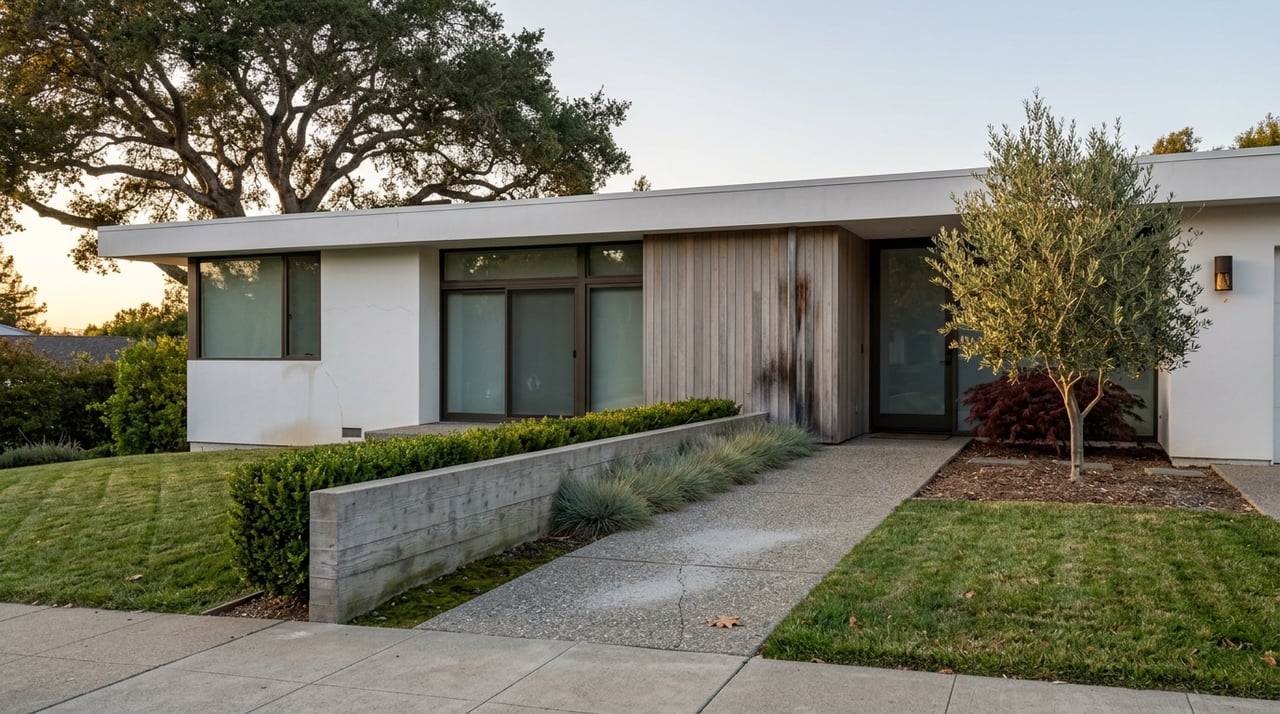
What Piedmont's Median Home Price Doesn't Include
Two buyers are comparing the same two listings this month. One is in Piedmont, the other just over the border in Oakland. They've both pulled up the median price for each city on a portal, done the math on a mortgage payment, and started building a budget around that number. Neither of them has looked at what happens to that number the month after they close, or at the four separate tax lines that show up on a Piedmont property tax bill that never touch an Oakland one.
That's the gap worth understanding before you get attached to a number you saw on a screen. Piedmont's price data moves more than it should for a market this small, and its ongoing costs run higher than the ad valorem tax rate alone suggests. Both facts trace back to the same root cause: Piedmont is a city of fewer than 4,000 homes, and nearly everything about how it prices and funds itself follows from that scale.
In February 2026, only 9 homes sold in Piedmont, and the median sale price landed at $2.45 million with homes spending 11 days on market, according to Redfin's monthly data. By May 2026, Redfin's own city tracker put the three-month median at $3,073,161, up 9.8% year over year, with 43 homes sold that month compared to 27 the year before.
The May three-month median is roughly 25% higher than the February monthly median, but the figures cover different measurement windows. The mix of houses that closed can affect these medians.
| Snapshot | Feb 2026 | May 2026 (median: 3-month) |
|---|---|---|
| Median sale price | $2.45M | $3,073,161 |
| Homes sold that month | 9 | 43 |
| Median days on market | 11 | ~12 |
When a city sells single digits of homes in a slow month, one large estate closing can pull the median up by hundreds of thousands of dollars. When 43 homes close in a stronger month, the mix normalizes and the number settles closer to whatever the underlying market is actually doing. Redfin's data through mid-2026 also showed the average sale price running even further ahead of the median, up 35.8% year over year in its most recent monthly read, compared to the median's 9.8% climb over the trailing three months. Averages get pulled harder than medians by a handful of high-end sales, and in a market this thin, a handful is all it takes.
Here's where it gets genuinely confusing if you're comparing sources side by side. As of May 2026, Zillow's home value index for Piedmont showed the typical home value at $2,533,749, down 6.9% over the past year. Redfin, tracking actual closed sales over the same window, showed the median up 9.8%.
Both can be right at the same time. Zillow's index is a modeled estimate across the full housing stock, sold or not, smoothed to reduce the effect of any single transaction. Redfin's median reflects whatever actually closed that month. In a market with thousands of monthly sales, those two methods converge because the sample size washes out the noise. In a market with well under 4,000 total homes, the noise is the story.
This is the part of the "Piedmont premium" worth walking through: the price you see quoted depends heavily on which handful of houses happened to trade in the window that source is measuring. The same small, tight-knit scale shows up outside the housing data too. When Piedmont Unified surveyed the community in late 2025 about renewing a school parcel tax, Piedmont Exedra reported that the firm running the poll said it had rarely seen initial support numbers as high as Piedmont's, calling it "the exceptional nature of your community." That's a school funding survey, not a housing statistic, but it points to the same underlying fact: this is a small enough city that its numbers, whether votes or home sales, don't behave like a bigger city's.
Piedmont is its own incorporated city with its own school district, separate from Oakland, and that separation shows up as a stack of assessments layered on top of the standard property tax bill. None of these scale with your purchase price. All of them apply whether you bought the smallest house on the flats or the largest estate in the hills.
Here's what was on the books for the fiscal year that just closed, based on the most recent published figures:
Add those up for a home of, say, 2,500 square feet as an illustration: $732 plus $3,051 plus $3,174 plus $1,250 from Measure P comes to just over $8,200 a year in assessments alone, before the standard ad valorem property tax bill is even calculated on the assessed value. A 4,000-square-foot home pays the same $732, $3,051, and $3,174, with only the Measure P portion scaling up with size. As a share of purchase price, that assessment total lands much harder on an entry-level Piedmont home than on a hillside estate five times its value.
None of this is unusual by California standards. Parcel taxes require the same two-thirds voter approval statewide, and Piedmont's community has approved one in some form nine times since 1985, according to the school district's own records. What's specific to Piedmont is how many separate measures are stacked concurrently, and how directly that stack ties back to the district's operating budget rather than to something optional.
Piedmont Unified's academic reputation is the single factor our own market analysis points to most consistently when explaining why buyers pay a premium to cross the city line from Oakland. That reputation is funded, in real dollars, by the parcel tax stack above. Buyers are effectively paying for the same asset twice: once in the purchase price premium the schools help create, and again every year in assessments that don't move with home value.
At the same time, that same demand, concentrated on a fixed and barely-growing supply of houses, is exactly what makes the monthly price data behave the way it does. A city this size can't generate enough transactions in any given month to smooth out the effect of one or two large sales. So the number you see quoted on any given day is a snapshot of whichever properties happened to close, not a stable read on where value sits.
A few practical adjustments are worth making before you anchor a budget to a single month's median:
Will my property taxes reset when I buy in Piedmont? Yes, under California's Prop 13 framework, a purchase triggers reassessment to the new purchase price, after which annual increases are capped. This applies statewide, not just in Piedmont.
Do the parcel taxes expire, or are they permanent? They're structured with terms and require renewal by a two-thirds vote. Measure H was just extended in June 2026, and Measure G's current term runs through 2028 unless renewed sooner.
Where can I confirm the exact tax total for a specific address? The Alameda County Assessor's Office, at (510) 272-6925, can provide the full combined total across city, county, and school district assessments for any Piedmont parcel.
If you're weighing a Piedmont purchase against a neighboring city and want the actual numbers run for a specific address, not just a portal estimate, that's exactly the kind of question our team spends time on before you ever write an offer. Reach out to DiMaggio Betta Group and let's get in touch.
This article is general information, not legal, tax or financial advice. Consult a qualified professional about your situation.
Stay up to date on the latest real estate trends.




Over and over again, that has been my experience
At DiMaggio Betta Group, luxury isn't defined by a price tag—it's defined by the level of service every client receives. We combine decades of experience, innovative marketing, and personalized strategies to ensure every property receives maximum exposure and every client enjoys a seamless, results-driven experience. Whether you're buying, selling, or investing, we're committed to exceeding expectations at every step.

DIMAGGIO BETTA GROUP
Mobile & Office: (510) 414-6777
DiMaggio Betta Group | Corcoran Icon Properties
CA DRE# 01047447
ADDRESS
342 HIGHLAND AVE
PIEDMONT, CA 94611